
Holy Curiosity: Questions, Creation, and the Mystery of God

Rev. AndreaGrace’s Prayerful Ponderings
I love questions. I mean, I really love questions.
I’ve been asking them since I was little—and I got into a lot of trouble for questioning those who had authority over me!
One of the lessons I’ve learned over the last couple of years is to discern whether an organization welcomes questions of self-reflection. And if it doesn’t… perhaps I should move on—and do so quickly!
Because questions can open us.
Questions can change us.
Questions can lead us more deeply into Mystery.
At One Spirit, my eyes—and my heart—were opened to nature in new ways. I began to appreciate the amazingness and vastness of all creation.
I began to recognize the Divine Engineer who designed such an extraordinary world…
the Divine Pulsating Energy—viriditas—the greening life-force flowing through creation…
the Divine Spark connecting a grove of trees that communicate with and protect one another…
and the Divine Pull drawing us toward the Divine One—known by so many names and images—like the gravitational pull of the moon upon the tides.
And I came to appreciate something else:
We need darkness.

It is in the darkness of night that we sleep and, hopefully, are restored.
It is in the darkness of the soil that roots are nourished.
It is in the darkness of winter that creation prepares for another season of growth.
It is in the darkness of the womb that new life grows.
And it is in deep darkness that we can see the stars shining most brightly.
Asking God Questions
Along the way, I’ve also learned that it is acceptable—even critical—to ask God questions.
Sometimes they are relatively easy questions:
Who should I reach out to today?
Which way should I go at this fork in the road?
But sometimes the questions are much harder:
Why is this happening to me?
Why is this happening to us?
Where are you, God, in the middle of this?
And perhaps one of humanity’s oldest and most difficult questions is:
Why is there suffering?
I don’t pretend to have a simple answer to that question.
But over the past few years, when I have brought my questions about suffering to God, I have often found myself being pointed back toward nature.
Nature reminds us that life includes cycles of birth and death, growth and letting go, darkness and light.
Think of a woman laboring to bring forth new life.
Think of an oak dropping its acorns. Some become food for animals. Some disappear into the earth. And some take root and become mighty trees themselves.
Not every suffering is necessary. Not every tragedy happens for a reason. And I definitely don't believe we need to call suffering good.
But our faith tells us something extraordinary:
Suffering and death do not get the final word.
This is at the heart of what we call the Paschal Mystery.
Jesus suffered. Jesus died.
And then came the Resurrection.
New life.
Not because the suffering itself was good—but because God's capacity to bring forth life is greater than death.
This week, I had the opportunity to sit at a playground on a huge tree branch that had been placed there.
I found myself looking at its rings and wondering about the life of this tree.
How old was it? What stories would those rings tell us about years of drought and years of abundant rain? Was the tree affected by diseases? What kind of tree was it? Who cut it down—and why?
And who looked at this fallen piece of a tree and imagined:
That would be wonder-filled in a playground.
Something that had reached the end of one life had become something new.
A seat for my little nephew and me.
And, because apparently I am still a child at heart, a balance beam for me on the way out of the playground!
Part of the Invitation
And maybe that's part of the invitation.
To wonder.
To question.
To be curious.
To be child-like.
To imagine.
To co-create with God.
These are spiritual gifts.
Nature - One of our Greatest Teachers
And perhaps nature is one of our greatest teachers—inviting us to practice them again and again.
So maybe we don't always need to rush toward answers.
Maybe sometimes the holiest thing we can do is pay attention.
To look.
To wonder.
To ask the question.
And then to listen for what might be revealed.
What is stirring in you? Is there an invitation for you as you move forward?
Exploring Images of the Divine in Nature
Have you considered:
God as Creator? How might you envision God as Creator?
Or the Holy Spirit as the vibrating energy in all of creation - something St. Hildegard called “viriditas”
Wisdom for the Journey
Readings:
Book of Job 38:1-9, 12-14, 16-18:
In this reading, God is announcing supremacy and God invites us into dialogue, even debate. God decided the size of the earth, where it would be, and what it would contain, and created everything that surrounded it. God raises the concepts of deepest darkest space, the vast expanse of the cosmos, and suggests it has boundaries that extend beyond what we can see. This is barely possible for we humans to comprehend. Who knows how far the universe goes? And are we to understand that it is not infinite – that there is something beyond it?! That is the supremacy God is announcing here – not only creator of all we know, but witness to everything beyond what we can comprehend.
Paul’s Letter to the Philippians 3:20-4:1
In this reading, we hear the reference to the “Cosmic Christ.” This is a term that has references in some of St. Paul’s letters and was called out by St. Irenaeus in the late 100s. It refers to the essence of Christ that extends beyond his humanity, that focuses on his connection to the cosmos – and is bigger than the boundaries we humans create around denominations, institutions, and religions. Modern theologians like Pierre Teilhard de Chardin, Matthew Fox, Richard Rohr and Joan Chittester are helping us to better understand the Cosmic Christ. Check out this contemporary translation of the passage
Our citizenship is in the heavens…
We are citizens of the Cosmos,
and we await the coming of the fullness of the Cosmic Christ.
Then, our own bodies will transform into glory.
Therefore, saints, you whom I love and long for, my joy and crown, stand firm in God, dear friends!
Matthew 21:23-27
In our first reading, we heard reference to asking questions and getting answers… This gospel passage gives us another example.
Asking questions and debating is an important part of the Jewish culture. Ismar Schorsch of the Jewish Theological Seminary wrote: “Judaism is a religion that not only permits but encourages us to ask questions. Because things are sacred does not mean that we have forfeited the right to think for ourselves.”
Take a moment to ponder this:
When you were a child, what messages did you receive about questioning? How has that message stayed the same or changed?
Spiritual Companion - St. Hildegard of Bingen
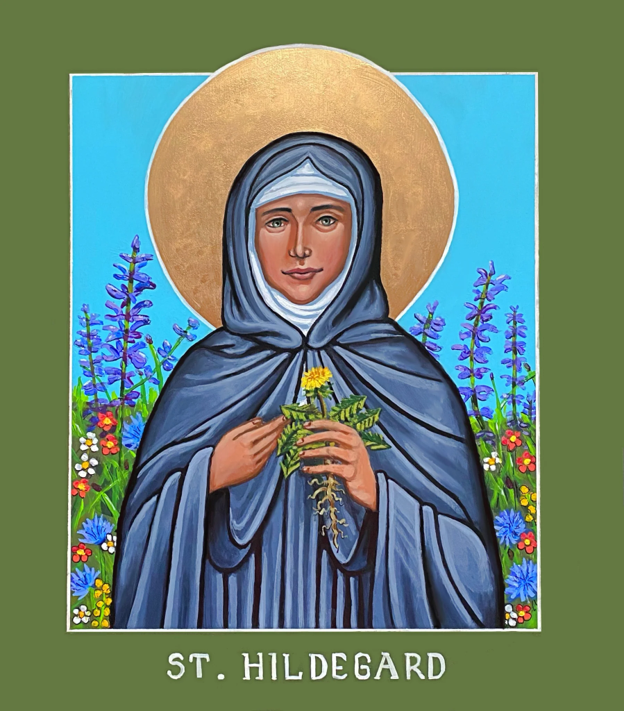
On Sept. 17, we celebrated the Feast of St Hildegard of Bingen. She lived from 1098-1179.
St. Hildegard was a Mystic who had visions since she was 3 years old
She gave us the term “viriditas” (meaning greening power, verdancy) – a term she used to refer to the Divine life force of the universe; a physical and spiritual energy; the presence of the Holy Spirit in our world – in plants, animals, fields, trees, water, air, and us.
She taught us that balance and health in our souls is tied to balance and health of the earth.
She believed nature contained the tools to restore viriditas in humans. She was one of the first to catalogue plants, trees, and stones for her botanical/medical book entitled: Physica.
At the age of 8, parents put her in the care of a count to be with his daughter who was 6 years older and also a mystic. They went into the convent together when Hildegard was around age 14. Eventually, she was elected to Mother Superior of her convent in 1136.
St. Hildegard was an incredibly prolific and multi-talented – writer, philosopher, composer, playwright, poet, naturalist, and feminist. She is sometimes considered the founder of natural history in Germany.
Praying with Music
“Seraphic Skies” - as we explore God’s grandeur, we pray with these Images from the Hubble Telescope set to a musical composition
God of Light and Creation - Psalm 104 What a Wonderful World
Try This Spiritual Practice
Let us open our eyes and heart to the love and goodness that is present in all of creation. As we contemplate our lives, let us speak from our heart to God - praising and thanking God for creation and the universe.
Perhaps begin with: “I praise you God for…” or “I thank you God for…”
LovingKindness In Acton
This week, consider spending some time outdoors. There are those who say:
God is
Go
Out
Doors
Pay attention. Take time
To look.
To listen.
To feel.
To wonder.
To ask questions that are on your heart.
And then to listen for what might be revealed.
Reach out to me here if you want to share about your experience.
A Blessing for Your Journey
This blessing is adapted from a saying by Lao-Tzu, the founder of Taoism, and is found in the book Prayers for Healing: 365 Blessings, Poems & Meditations from Around the World edited by Maggie Oman Shannon. This is from the entry for June 29.
Be blessed
So that you may
settle your mind
as the universe settles the stars in the sky.
Be blessed
so that you may Connect your mind with the subtle Origin
and be calmed.
Be blessed
that once you are calm,
your mind will naturally expand
and become as vast and immeasurable as the night sky.
Want to explore this with others?
This was based on an Eucharistic Liturgy co-created with Carol and celebrated by the BeLoved Inclusive Community during the Season of Creation on the 25th Sunday Ordinary Time Cycle A. Reach out for more information here.
If this blogpost prompted you to think of someone…. Please forward it!


Comments